

One of the most common questions we get asked is: "What is my personal injury case worth?" While it may seem like a straightforward question, the answer is anything but simple. The value of your personal injury lawsuit depends on numerous factors. These include your medical care, lost wages, and general damages like pain and suffering.
Understanding the components that determine case value can help set realistic expectations. DeShaw Law stands ready to answer any questions you may have about the factors that affect your personal injury case value.
We live in an era of misinformation, and the legal field is not immune. Settlement calculators and settlement lawyers will over promise to get you to sign with them, and under deliver when it comes to obtaining a fair settlement offer for your injuries. We would rather give you the facts and let you decide if you would rather have a big promise or a big outcome at the end of your case.
Some people think that their case is worth millions simply because they’ve suffered; unfortunately, this is not true. Emotional suffering is real—and potentially collectible—but it must be backed by evidence. Without proper documentation, even cases of extreme suffering become uncollectible.
Some think that the defendant is guaranteed to pay because they’ve admitted fault. However, admitted liability is only one factor in your case’s strength. Moreover, even winning your case at trial doesn’t guarantee that you will be able to recover money from your claim. Defendants without insurance may be judgment-proof, meaning recovery could be difficult or impossible.
For these reasons and more, we will never guarantee a specific case value or outcome. Instead, we provide an educated estimate based on their experience with similar cases. In the meantime, follow your doctor’s medical treatment plan, document everything, and be patient with the process. The insurance company’s first offer is often a low-ball amount.
What is your injury case worth? Call the personal injury attorneys at DeShaw Law for a free, comprehensive case evaluation: (503) 227-1233.
7 Factors That Affect Your Personal Injury Case Value
1. Case Type
Different types of cases are valued differently. For example, in a contract dispute, damages will involve a business’ financial losses. In a defamation case, case value will center around the person’s reputational harm.
The settlement for a personal injury case will factor in your medical expenses, lost wages, pain and suffering, and future care costs. The final value is usually determined through pre-trial negotiations. If a fair settlement cannot be reached, your case value will be determined by a trial jury.
2. Liability and Strength of Evidence
Proving liability is vital for any personal injury case. A case is only as strong as the evidence supporting it—and your case’s value is dependent on the evidence in your favor. If liability (who is at fault) is undisputed, the value of your case generally increases.
If there is uncertainty as to who is at fault, you may receive a lower settlement. In cases where evidence is insubstantial, the defense will argue for a full dismissal. In these cases, you would get nothing. Your Oregon personal injury lawyer will work hard to determine liability.
In Oregon, you will need to be found less than 50% at fault to collect on your claim. In Washington, you can receive compensation that is reduced by the percentage you are at fault - often referred to as "pure comparative negligence."
3. Damages
“Damages” refer to the losses experienced by the plaintiff (the person bringing the lawsuit). Two types of damages come into play: economic (e.g., medical bills, lost income, property damage) or non-economic (e.g., pain and suffering, emotional distress, loss of enjoyment of life, loss of consortium). Courts and insurance companies rely on documented evidence—receipts, pay stubs, medical records, and so forth—to calculate economic damages. By contrast, non-economic damages are subjective and can vary widely based on jurisdiction and the persuasiveness of your argument.
Economic damages will be affected by a number of factors, including age, work-life expectancy, loss of future earnings and wage growth rate, inflation, future medical expenses, life expectancy, and more. In high-value cases, your Oregon personal injury attorney will bring in a forensic economist to calculate the present value of your damages.
A forensic economist’s damages schedule may look something like this:
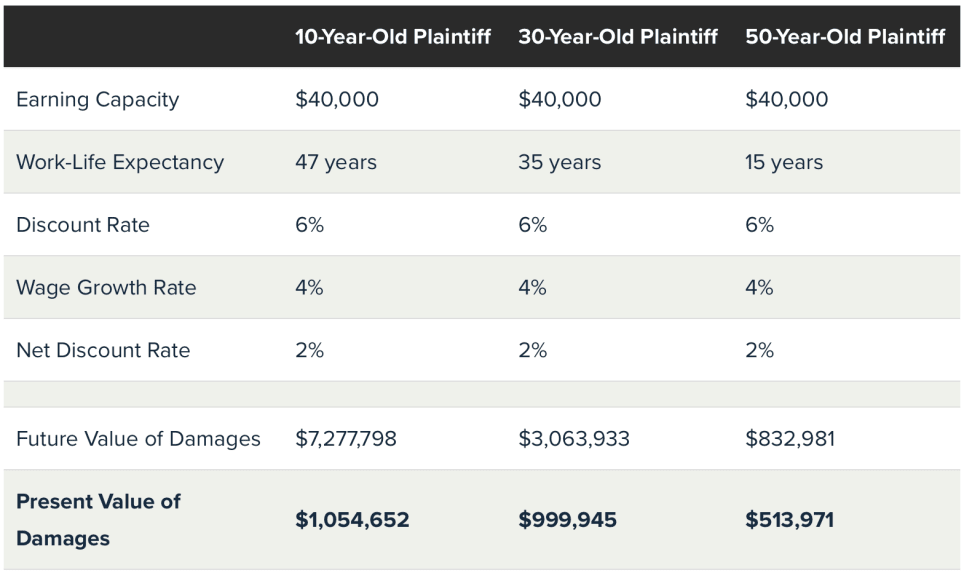
Source: The Knowles Group: Determining Present Value of Damages
In cases where the defendant’s behavior is deemed particularly egregious or malicious, case value may also include punitive damages. These are damages intended to punish the defendant and can be substantial; depending on the severity of their negligence, this can add millions of dollars to a settlement of verdict.
What is the multiplier method?
The multiplier method is a calculation used to determine the value of pain and suffering. This method involves multiplying (1.5-5x) the plaintiff's economic damages, like medical bills and lost wages. The multiplier is based on the severity of the injuries and the degree of pain and suffering.
Please note that while some older lawyers still discuss the "multiplier method" it has long been discarded by insurance companies given that they have been using insurance claim software to make settlement offers since the mid-1990s that offers far lower than the 2-3x economic damages once used as common settlement method before the 1990s. We know, because our lead lawyer, Aaron DeShaw, has researched these systems for over 20 years and has written textbooks for lawyers on how insurance companies evaluate claims.
Any lawyer that believes the multiplier method is still being used is more than two decades behind on how insurance companies actually evaluate claims.
4. Jurisdiction and State Laws
The jurisdiction where your case is filed can have a significant impact on its value. Laws regarding damages caps, comparative fault, and jury tendencies differ by state, county and even by judge. For decades, insurance companies have internally tracked the outcome of a law firm's cases to set settlement values to their clients. Insurers now use AI to track lawyer and judge analytics using programs such as Premonition to track lawyer win rate. This directly impacts settlement offers. Online personal injury settlement calculators are not sophisticated enough to account for these factors. You should speak with an experienced personal injury lawyer about these issues to understand how these factors relate to your case. If the personal injury attorney doesn't understand that these factors are being used to evaluate your claim, that signals a potential problem.
The state of Oregon operates under modified comparative negligence. This means that the plaintiff can collect damages as long as their fault is not found to exceed 50%. Oregon has a $500,000 cap on noneconomic damages like pain and suffering in wrongful death cases, but has no cap on noneconomic damages in cases for people who are injured but are alive at trial. Oregon has no cap on punitive damages, but 70% of the punitive damage award is taken by the State of Oregon.
By contrast, the state of Washington has pure comparative negligence. This means that an injured person can get some damages even if more than 50% at fault, but the amount is reduced by the judge by the percentage of fault determined by a jury. Washington has no punative damages except, in some cases where the defendant is an out of state company that could be subject to their own state's laws on punative damages.
5. Insurance Policy Limits
In many auto injury cases, the defendant’s insurance coverage limits the potential recovery. If a car accident results in $500,000 in damages, you may only be able to recover up to the policy limit of that driver's insurance unless the defendant has significant personal assets. Finding additional insurance policies is very common at our Portland personal injury law firm, and we are highly successful in finding additional insurance coverage. We handle cases involving serious permanent injuries and in most of our cases there is insufficient insurance to cover our client's personal and financial losses. To the extent our Oregon personal injury lawyers can find additional insurance coverage, it can make the difference between the client having a life changing financial loss, and getting fair compensation for their injuries.
It is also important to speak to an Oregon personal injury lawyer before settling your case against an at fault driver or their insurer, because doing so may destroy an additional claim for Underinsured Motorist you have with your own insurance company. Call our Portland personal injury lawyers at (503) 227-1233 for more details.
6. Settlement Methods
The settlement of a personal injury case relies upon one primary method; a demand letter to an insurance company.
This is one of many areas where our personal injury law firm shines. Over 20 years ago, our lead lawyer Aaron DeShaw, researched insurance claim software and created a proprietary method of writing demand letters based upon the factors used by the insurance companies. That method provides the information of value to the insurance company in the order required by the insurance company. Even more, using Dr. DeShaw's research we are able to identify the claim software used by the insurer involved in your claim and optimize the demand letter information, language and layout based upon that claim software. This provides insurers all of the information on our clients personal injury cases that they need to fully, fairly and properly evaluate the claim. In addition, there are some injuries (such as traumatic brain injuries) that require further analysis and discussion because as Dr. DeShaw discovered, there are 22 types of injuries not evaluated by some insurance claim software. DeShaw's methods of writing demand letters is the subject of several books, legal journal articles, legal educational videos, and the AI Demand letter company Settlement Intelligence.
Research by legal publisher Trial Guides, demonstrates that the majority of personal injury lawyers still write demand letters in a way that fails to acknowledge that insurance settlement offers are generated by claim software. Without addressing the injuries, treatment, impairment, disability and other factors of value to an insurance company, a lawyer cannot get the full settlement offer available on a claim.
7. Going to Trial
Most cases settle before reaching trial. In some cases, however, a settlement cannot be reached; these cases often involve large damages that the insurance companies hope they will not have to pay. Even a strong case with clear liability and significant damages may not settle for close to its full value. But, when an insurance company makes a low ball offer on a serious injury case, we will go to trial and let a jury decide.
When weighing your options about which Oregon personal injury attorney to retain, it is important to look at their trial history, particularly how often they go to trial.
Some lawyers beg for anything an insurance company is willing to pay because they are scared of trial. According to the Insurance Research Council personal injury lawyers settle 98% of cases before filing a lawsuit. According to the U.S. Department of Justice Bureau of Statistics research on state courts, of the remaining 2% (or less in Oregon), 98% of those cases settle prior to trial. By contrast to settlement law firms, we accept every case preparing for our cases to go to trial. Depending upon the time frame, we file 60-70% of our cases for litigation (instead of the 1-2% average), and we regularly go to trial on the cases we file. We don't accept low ball offers from insurance companies to make a quick buck and avoid the time, cost and stress of trial. We know that every person we represent has an injury that significantly impacts their life and is likely to permanently impact their life. You can see the difference that our approach makes by comparing our case outcomes versus other Oregon personal injury law firms. While every case has different facts and will have a different financial outcome, this gives you an idea of the data insurers will have when considering how to evaluate our clients cases.
While some insurance companies will push cases to trial no matter what in hopes of winning, some insurance companies do not want the risk of going to trial on a serious injury case with a jury that will hold them accountable. Having an experienced trial lawyer by your side is often enough to encourage their cooperation during settlement negotiations.
We can discuss more factors during your free consultation.
DeShaw Law offers free, confidential consultations on the phone, by video conference, or in person.
Determining what your personal injury case is worth involves more than just a quick calculation; it depends on various legal, factual, and strategic factors. The experienced attorneys at DeShaw Trial Lawyers will always keep you informed about the factors that affect your case value.
If you’re wondering what your case might be worth, talk to the experienced personal injury lawyers at DeShaw Trial Lawyers today: (503) 227-1233.