

The failure of CT and MRI to show brain injury
If you are looking for an Oregon brain injury lawyer, it is important to hire a lawyer that doesn't just advertise for brain injury cases, but actually knows about all of the nuances of traumatic brain injuries and how insurers defend TBI cases. This includes why CTs and MRIs fail to show brain injuries in most cases.
Some people (including many doctors) incorrectly believe that a negative CT or MRI is definitive proof that an injured person did not experience a traumatic brain injury. But the consensus statements defining a Mild Traumatic Brain injury by the American Academy of Neurology, and the American Congress of Rehabilitative Medicine do not require a positive MRI or CT for a doctor to render the diagnosis of concussion, mild traumatic brain injury or post-concussion syndrome. As discussed at length in this related post on brain MRIs, the microscopic damage that occurs in a mild traumatic brain injury is too small to be seen on even the best brain imaging available. Only brain bleeds or skull fractures associated with moderate traumatic brain injury and severe traumatic brain injuries are detected on imaging.
Even in cases with a negative MRI and a normal Glasgow Coma Score, some patients die of TBI
Our Portland brain injury lawyers have handled cases where a "mild traumatic brain injury" has killed the client. In one case we handled, a moderate rear end collision resulted in the death of the client several days after the crash due to a slow brain bleed. The client didn't believe he even needed medical care until it was too late for doctors to save him.
Actress Natasha Richardson died of a "mild" TBI
One of the best known cases of death following a "mild" TBI was leading actress Natasha Richardson, and wife of actor Liam Neeson. Richardson had no loss of consciousness and had a perfectly normal score of 15 (maximum) on the Glasgow Coma Scale after a snow skiing incident. According to a news story by ABC News, "She initially appeared fine and joked about the fall, but the ski patrol insisted she see a doctor. Richardson declined, the resort said in a statement Tuesday." She was dead the next day due to a brain bleed that was not evident the first day. In response the ambulance service noted "'When you have a head trauma you can bleed. It can deteriorate in a few hours or a few days,' Coderre added. 'People don't realize it can be very serious. We warn them they can die and sometimes they start to laugh. They don't take it seriously.'"
CT and MRI almost never detect a Mild Traumatic Brain Injury
When a patient receives a report that they don't have a brain injury the first thing to note is that medical research demonstrates that even in the best Level I trauma hospitals in the United States, 56% of mild traumatic brain injuries are not diagnosed. See Powell JM, et al. “Accuracy of Mild Traumatic Brain Injury Diagnosis,” Arch Phys Med Rehabil 2008; Vol. 89: 1550-5. So, a brain injury is missed in more cases than it is correctly diagnosed even in the best trauma hospitals in the country.
Similarly, a hospital or doctor claiming a patient doesn't have a brain injury if a CT or MRI is negative is clearly not accurate given that US National Institutes of Health and Center for Disease Control provide physician education materials noting that imaging is negative in 80% of all brain injury cases.
Medical research conducted by pioneering neuroscientist Erin Bigler notes one such case. “Autopsy studies were undertaken in a 47-year-old college-educated male patient who, 7 months prior to an unexpected death, had sustained a mild traumatic brain injury (TBI) as manifested by brief loss of consciousness and an initial Glasgow Coma Scale score of 14 [which is considered normal and 1 point below the maximum of 15]. The patient died from cardiac arrest secondary to an undiagnosed and unknown arteriosclerotic cardiovascular disease as assessed by the coroner's office at the time of autopsy. Gross inspection of the brain at autopsy was normal; however, microscopic analysis demonstrated what were considered trauma findings of hemosiderin-laden macrophages in the perivascular space and macrophages in the white matter, particularly the section taken from the frontal lobe. The patient had partially returned to work at the time of death but had encountered problems with diminished cognitive performance in his work as an appraiser. Neuropsychological studies were generally within normal limits although several tests of either speed of processing or short-term memory showed lower than expected performance. This case demonstrates the presence of subtle neuropathological changes in the brain of a patient who sustained a mild TBI and was still symptomatic for the residual effects of the injury 7 months post injury when he unexpectedly died.” Bigler, E. et al. “Neuropsychological results and neuropathological findings at autopsy in a case of mild traumatic brain injury” Journal of the International Neuropsychological Society Volume 10, Issue 05, pp 794-806 (September 2004).
MRI and CT do not detect advanced brain damage in CTE
In 80% of all brain injury cases advanced medical imaging including CT and MRI show no abnormal findings. Surprisingly, this includes veterans who sustain mild traumatic brain injuries in IED explosions, as well as professional athletes with multiple concussions / mild traumatic brain injuries.
Even more shocking is that this includes even the most advanced cases of Chronic Traumatic Encephalopathy ("CTE") seen in cases of NFL football players, NHL hockey players and others with history of multiple concussions. Our Oregon Brain Injury Law Firm has represented former NFL players in brain injury claims, and have been contacted by out of state families of former NHL players who committed suicide as the result of CTE despite Oregon having no NFL or NHL teams.
CTE is a progressive degenerative brain disease caused by repetitive head impacts, even in the abscence of signs of concussion or mild traumatic brain injury. CTE has been associated with behavioral symptoms like aggression, impulsivity, explosivity, depression, anxiety, paranoia, and suicidal ideation, along with progressive cognitive symptoms. One would think that with such severe brain injury symptoms, something would show up on MRI or CT, but that is not the case. Publications by the United States National Institutes of Health, are definitive on this issue; "Chronic traumatic encephalopathy cannot be diagnosed on imaging." See Shetty T. et al. "Imaging in Chronic Traumatic Encephalopathy and Traumatic Brain Injury" Sports Health 2016 Jan;8(1):26–36. Also, see the University of Michigan School of Medicine page on imaging in CTE.
In a series of high profile class action lawsuits for brain damage sustained by NFL players, few if any of these players demonstrate any findings on the best MRI machines even though over 99% of NFL players who's brains are dissected after death have extensive brain damage classified as Chronic Traumatic Encephalopathy or "CTE." Since CT and MRI cannot even demonstrate extensive brain damage associated with CTE, the condition can only be diagnosed after the death of the player in a brain autopsy.
In a landmark study of CTE in athletes published in the Journal of the American Medical Association in 2017, titled "Clinicopathological Evaluation of Chronic Traumatic Encephalopathy in Players of American Football" researchers from VA Boston Healthcare System (VABHS) and Boston University School of Medicine studied 202 deceased American football players whose brains were donated for research. The researchers found CTE in:
- 110 of 111 National Football League players (99 percent);
- 48 of 53 college players who did not play football beyond college (91 percent); and
- 3 of 14 football players who did not play beyond high school (21 percent).
The severity of the CTE demonstrated a correlation between the history of play, the number of head strikes (as opposed to concussions), and the resulting severity of the brain damage. All former high school players demonstrated mild brain pathology, while the majority of former college, semi-professional and professional players demonstrated severe pathology. According to the lead researcher, “we found cognitive, mood and behavioral symptoms were very common, even among players with mild CTE tau pathology."
In a separate study on former NFL hockey players published by the American Medical Association in the journal Neurology, 27 out of 28 had CTE (96.4 percent).
The mood and behavior problems associated with traumatic brain injury included domestic violence and criminal behavior, including at least two cases that have gained international news coverage.
Aaron Hernandez - Severe CTE leads to violence despite no positive CTs or MRIs demonstrating brain damage.
NFL player Aaron Hernandez had a storied football career scoring in five Super Bowls and obtaining a $40 million contract in his early 20s.
Hernandez started playing pee wee football at a young age, then played football in high school, college (national champs), and was drafted into the NFL by age 20.
Hernandez started showing significant behavioral problems in college. He was nearly thrown off team. He got in a bar fight in 2007 (age 18) where he allegedly shoots a person. The case is settled out of court.
In the early days of his NFL career Hernandez started exhibiting increasingly violent behavior. Teammates described him as “wildly unpredictable” with explosive anger. Several pictures show him with guns, including a 2009 social media post holding a weapon (which becomes relevant later.)
At age 23 (2012), Hernandez allegedly kills two men. A third man claims he was shot in the face by Hernandez at the same time. Hernandez isn’t arrested. Instead, he signs a $40 million NFL renewal contract the next month.
Eleven months later at age 24 (2013), he kills a “friend” of his with two other people in the car. He is arrested this time. He allegedly kills the man with the gun he pictured himself with in the 2009 social media post.
Was brain damage from football the cause of his violent behavior? No one in the legal system could know because... MRI and CT can't show most brain injuries even when the damage is extensive. He was represented by celebrity criminal defense lawyer Jose Baez, for the charges in the first and second alleged murders, who would have used the brain damage as a mitigating factor had there been any brain imaging to prove it.
Hernandez was convicted of the third murder and given a life sentence. Then in a second trial, he was acquitted of the first two murders.
Five days after his second trial while in jail for his life sentence, he committed suicide at age 27. His brain was donated for CTE research to Boston University.
An autopsy of Aaron Hernandez's brain demonstrated Stage 3 CTE, the most extensive damage seen in a person of his age. On autopsy there are large areas of damage, multiple small holes and extensive hemorrhage in the brain. None of which showed up on MRI or CT.
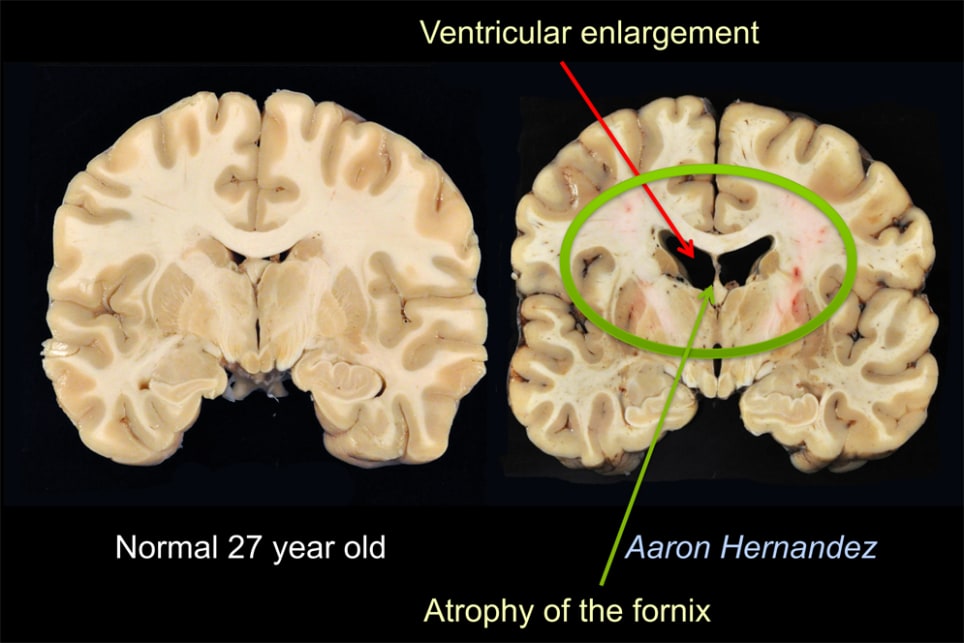

Even Extensive Brain Damage Cannot be Seen on MRI or CT
What is our point? Just because an MRI or CT comes back as negative does not mean that a person does not have a brain injury. MRI and CT cannot even detect the most extensive CTE damage ever seen on autopsy.
Experienced Brain Injury Lawyers Understand Brain Imaging and its Limitations
Why is this important? If you have a brain injury legal case, you better have a lawyer that understands that a brain injury isn't going to show up on MRI or CT. Because the insurance lawyers and the insurance doctors will tell the jury that if you had a real brain injury it would show up on MRI or CT. That comes up in nearly every brain injury trial. And without a real brain injury lawyer representing you, your likelihood of losing is high if the jury actually believes that. The insurance companies know which lawyers understand TBIs and which ones are successful in trial in TBI cases. If you don't have one of those lawyers, good luck getting a fair settlement offer.
You might have noticed that throughout this post, and on this web site there are many medical journal articles referenced on the topic of traumatic brain injury. Check other law firm web sites to see if they have that same expertise. Our firm has a database of over 500 medical journal articles on a variety of topics related to traumatic brain injuries, as well as hundreds more on other types of traumatic injuries. Why? We want to understand the science on your injuries better than the insurance doctors who will be hired to defend your case.
Now look at the case outcomes of the lawyer you will be assigned in your case. Is it an identifiable lawyer with experience in your state, or one of hundreds of lawyers in a large national firm that has no experience trying cases in Oregon or Washington, and who has no experience with the local defense lawyers or defense doctors? Now look at the lawyer's case outcomes in Oregon or Washington. We have the largest personal injury compensatory damage jury verdict in Oregon history, as well as some of the highest outcomes in Oregon history for traumatic brain injury cases.
If you or a loved one has a traumatic brain injury case and need an experienced Oregon brain injury lawyer, contact our office or call (503) 227-1233 for a free consultation.
What brain testing is better for diagnosing traumatic brain injuries if MRI and CT can't show the brain damage?
While no tests are 100% accurate at diagnosing a traumatic brain injury, the most sensitive tests for brain injury are neuropsychological testing and computerized visual system testing. As already noted, medical imaging is amongst the least sensitive tests for TBI because it does not detect 80% of all traumatic brain injuries. When it does, these are almost always classified as moderate or severe TBIs that involve brain bleeds.
Philip Adams - Moderate CTE leads former NFL player to commit six murders despite no positive CTs or MRIs demonstrating brain damage.
Philip Adams played seven years in the NFL. Adams died by suicide at age 32 on April 7, 2021 after fatally shooting six people in Rock Hill, South Carolina. His family donated his brain to be studied by leading CTE researchers at Boston University. Neuropathologists at the Boston University CTE Center found that Adams had stage 2 chronic traumatic encephalopathy (CTE).
“Phillip Adams had an extraordinary amount of CTE pathology in the frontal lobe, the area of the brain behind the forehead. Frontal lobe damage is associated with violent, impulsive or explosive behavior, a “short fuse,” and lack of self-control,” said Dr. Ann McKee, chief of neuropathology for the VA Boston Healthcare System and director of the BU CTE Center and VA-BU-CLF Brain Bank. “His CTE pathology might have contributed to his abnormal behaviors, in addition to other physical, psychiatric and psychosocial factors. His predominantly frontal lobe CTE pathology, which resulted in atrophy, or shrinkage, of the brain, was similar in severity to Aaron Hernandez.”
Frontal lobe injuries are a common type of traumatic brain injury in people injured in auto accidents, truck crash cases, airplane crashes, explosion cases and many other types of cases handled by our brain injury lawyers. These can permanently change a person's life as it did for Philip Adams and the people he murdered when his brain was damaged.
Over the past two years, Adams’ behavior shifted dramatically, according to his sister.
“His mental health degraded fast and terribly bad,’’ Lauren Adams said. “There was unusual behavior. I’m not going to get into all that (symptoms). We definitely did notice signs of mental illness that was extremely concerning, that was not like we had ever seen."
While most people associate brain injuries with cognitive changes such as memory loss, even in brain injuries that are not CTE, behavioral changes are common as are increases in psychological conditions such as PTSD, anxiety and depression. If you are having cognitive changes, behavioral changes, psychological changes or neurological changes after a traumatic brain injury it is important to discuss these changes with a licensed health care provider.
If you or a loved one has a traumatic brain injury case and need an experienced brain injury lawyer, contact our office or call (503) 227-1233 for a free consultation. We also work with other law firms who want us to try their most serious brain injury cases. Contact us to learn more.