

Glasgow Coma Scale Score in TBI Claims
The Glasgow Coma Scale score is a common area of dispute during traumatic brain injury claims and trials. Over the past 25 years, over 90% of our cases have involved traumatic brain injuries. As a result, our brain injury lawyers have experience in handling issues that can win or lose a TBI case. One of these issues is the client's Glasgow Coma Scale score. In this article we consider how GCS should and should not be used in a TBI case, and why hiring an experienced brain injury lawyer can make the difference between winning and losing your case.
Glasgow Coma Scale Score: How It Diagnoses Traumatic Brain Injury
The Glasgow Coma Scale score is a common clinical tool used to assess the level of consciousness and classify the severity of a traumatic brain injury (TBI) immediately after injury. First developed in 1974 by neurosurgeons Graham Teasdale and Bryan Jennett at the University of Glasgow, the GCS gives clinicians an objective, reproducible way to communicate a patient's neurological status.
What is the Glasgow Coma Scale Score?
The Glasgow Coma Scale score is a numerical rating from 3 to 15 based on three observable patient responses: eye opening (E), verbal response (V), and motor response (M). A score of 15 indicates full consciousness, while a score of 3 — the lowest possible — reflects complete unresponsiveness. Each component is recorded separately (e.g., GCS 10 = E3V4M3) to provide a detailed clinical picture, and the three values are summed into a total Glasgow Coma Scale score for rapid triage.
How is the Glasgow Coma Scale Score Calculated?
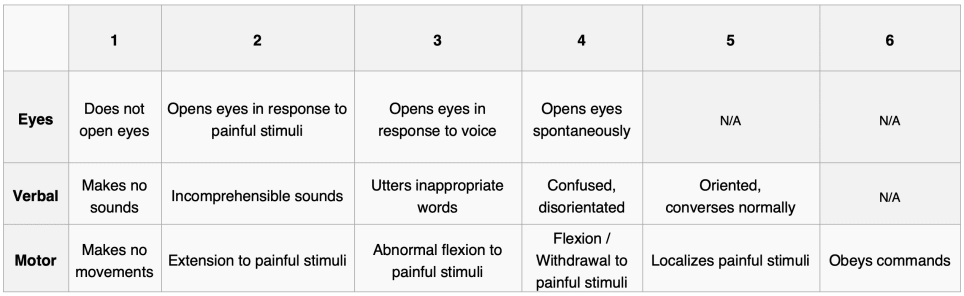
Glasgow Coma Scale score is calculated on the basis of the responsiveness of three things:
- Eye Opening (E) - 4 points maximum
- Verbal Response (V) - 5 points maximum
- Motor Response (M) - 6 points maximum
The following is a table representing the Glasgow Coma Scale scoring that our brain injury lawyers created for our TBI trials:
When is Glasgow Coma Scale score measured?
One of the areas of dispute in a brain injury claim is when the Glasgow Coma Scale score is measured. As noted above, the original intention was to measure the person immediately after injury. In cases when the person is knocked unconscious during the event, that is a Glasgow Coma Scale score of 3. As discussed below, this is considered a severe brain injury.
Insurer's didn't like the implications of the immediate rating on TBI claims. Over time, some medical studies suggested taking the Glasgow Coma Scale score 20 minutes or even 30 minutes after the trauma, so that the person could be pushed back to consciousness by another person before EMTs or other medical personnel arrived on the scene. So, we have represented a number of clients where the GCS following a serious injury was 3, but by the time the EMTs arrived at a remote location more than 30 minutes after the injury, the client was measured to have a GCS of 13-15 (considered a "mild" TBI).
As you read on, you will realize that in all but emergency situations, there is not a significant difference in symptoms between someone that has a GCS of 3 and a GCS of 15. Both have a probability of TBI symptoms and persistent or permanent symptoms, although the rate of permanency and severity of symptoms can be higher in severe traumatic brain injuries.
Does a GCS of 15 mean the person doesn't have a TBI?
Here is another point of disagreement in TBI claims and trials. The science is solidly on the side of injured people.
Does a person having a Glasgow Coma Scales score of 15 (maximum) after 20 or even 30 minutes mean the person didn't have a brain injury? No. The Glasgow Coma Scale score has not been used to determine the diagnosis of concussion or traumatic brain injury since the early 1990s.
In fact, in order to have a designation as a "mild traumatic brain injury" you must have a GCS score of 13 to 15 when measured. So the fact that a person is tested as having a GCS of 15 after 20 or 30 minutes or more is not a determining factor in diagnosing a TBI.
What is the Purpose of the Glasgow Coma Scale Score in a TBI?
An abnormal Glasgow Coma Scale score is not required to have a concussion or mild traumatic brain injury.
The only relevance that Glasgow Coma Scale score has is in an older (and increasingly disregarded) classification of the TBI as "Mild TBI," "Moderate TBI" or "Severe TBI." (The medical profession is now calling for these designations of mild, moderate and severe to be discontinued as they are not predictive of a patient's symptoms or outcome.) The term used by some doctors "significant TBI" or "serious TBI" does not fall within any formal medical terminology, and is not designated by a particular Glasgow Coma Scale score.
Glasgow Coma Scale Score and TBI Severity Classification
The total Glasgow Coma Scale score directly determines how a TBI is classified using the old classification system, and can guide emergency department treatment decisions.
Approximately 80% of all TBI cases are classified as mild based on a 30-minute post-injury GCS of 13–15. Severe TBI — a GCS score of 3 to 8 — involves immediate loss of consciousness for more than 6 hours, and these patients carry the highest risk of death and lasting disability.

How the GCS Score Is Used in Diagnosis
The Glasgow Coma Scale score is typically administered by emergency medical personnel at the scene and again upon hospital arrival. It is incorporated into major clinical frameworks including Advanced Trauma Life Support (ATLS), Brain Trauma Foundation guidelines, and ICU scoring systems like APACHE II and SOFA. Doctors use the GCS score alongside CT scans, MRI imaging, and neurological exams to build a complete TBI diagnosis — but the GCS score is the fastest, most standardized first-line assessment available.
In pediatric patients, the threshold for severe TBI is adjusted: a GCS score of ≤5 (rather than the adult cutoff of ≤8) more accurately identifies life-threatening injury, as children with scores of 3–5 show markedly higher mortality and morbidity.
Limitations of the Glasgow Coma Scale Score
While the Glasgow Coma Scale score is widely trusted, it has recognized limitations:
- The delay in performing the GCS to 20 minutes, 30 minutes or longer, does not provide an accurate designation as the system was originally designed. People who may have had a GCS of 3 (severe TBI) may have a GCS of 15 by the time they are first checked some time after the injury after extensive efforts to revive them.
- Sedation and neuromuscular blockade can artificially suppress GCS scores, making results unreliable in intubated patients
- Inter-rater reliability varies by component — verbal response agreement has been measured as low as 55% across clinicians
- The GCS was originally designed for adults, requiring pediatric modifications for children under 2 years old
- International TBI experts, including those working with the NIH's National Institute of Neurological Disorders and Stroke, are actively developing more accurate multi-dimensional TBI classification systems to supplement the GCS
Clinical and Legal Significance of a Glasgow Coma Scale Score
In personal injury and TBI litigation, the documented Glasgow Coma Scale score at the time of injury can carry significant evidentiary weight, particularly if the personal injury lawyer doesn't understand its lack of significance. A GCS score of 3–8 at the time it is first checked (whenever that is) may be treated as objective clinical evidence of severe TBI, supporting claims for long-term care, lost wages, and pain and suffering damages. Insurance company adjusters and jurors may rely on initial GCS documentation as a baseline marker for injury severity when evaluating claims although as discussed in this article, that is misguided.
People Can Die with an Initial GCS of 15
One of the best known cases of death following a "mild" TBI was leading actress Natasha Richardson, and wife of actor Liam Neeson. Richardson had no loss of consciousness and had a maximum Glasgow Coma Scale score of 15 (maximum) after a snow skiing incident. According to a news story by ABC News, "She initially appeared fine and joked about the fall, but the ski patrol insisted she see a doctor. Richardson declined..." She was dead the next day due to a brain bleed that was not evident the first day. In response the ambulance service noted "'When you have a head trauma you can bleed. It can deteriorate in a few hours or a few days,' Coderre added. 'People don't realize it can be very serious. We warn them they can die and sometimes they start to laugh. They don't take it seriously.'"
Notably a consensus statement on TBI treatment published by multiple specialty associations in the medical profession has noted the following on this issue; "Chronic subdural hematoma may develop slowly after TBI, manifesting after several weeks or even months with headache, hemiparesis, speech difficulties, gait abnormalities, and/or cognitive decline, typically in older adults or younger patients with a non-operatively managed subdural hematoma." Death can occur even in cases with a negative CT after a mild traumatic brain injury. Risk factors include older age, antiplatelet or anticoagulation use.
Our law firm has represented the family of a client that died a few days after a TBI with a Glasgow Coma Scale score of 15.
Glasgow Coma Scale score does not determine if a person sustained a traumatic brain injury
The issue of GCS score is the not the deciding factor in whether a person has sustained a traumatic brain injury or concussion. Medical research and the US Governmental agencies have long accepted that there is no requirement for a loss of consciousness for a brain injury to occur. One important society that has provided a consensus statement on this is the American Academy of Neurology, which states that at minimum, a loss of consciousness qualifies as a Grade 3 (the worst) mild traumatic brain injury. The following is a summary from a definitive view of all of the standard definitions of traumatic brain injury in an article called “Neuropsychology and Clinical Neuroscience of post-concussion syndrome” Journal of the International Neuropsychological Society, 14, 1-22 written by prominent brain researcher Erin Bigler, Ph.D. The first demonstrates Grade 1, Grade 2 and Grade 3 mild traumatic brain injury definitions from the American Academy of Neurology consensus statement.

The next graphic from the Erin Bigler article, discusses that a mild traumatic brain injury occurs when any one of the following signs or symptoms occur. The most common of these is #3; a change in mental state, meaning that a person feels dazed, disoriented or confused following the injury.

Glasgow Coma Scale score fails to demonstrate material differences long term
Medical research suggests that there are not material differences in the symptoms experienced after TBI between people who have the lowest score 3 and those who score the maximum score of 15.
Dr. Marvin Bergsneider’s work at UCLA shows that the Glasgow Coma Scale (GCS) only partially reflects what is happening with brain metabolism after traumatic brain injury, and in some regions it doesn’t track it well at all.
Global cortical metabolism vs. GCS are largely dissociated
In a PET study of head‑injured patients, cortical cerebral metabolic rate of glucose (CMRglc) was markedly reduced in most patients across the severity spectrum, with the global cortical CMRglc correlated very poorly with GCS level of consciousness. Stated more simply, there was almost no difference in glucose metabolism in the brain between patients who had a GCS score of 3 and patients who had a GCS of 15. This led Bergsneider and colleagues to conclude that reduced cortical glucose metabolism after TBI is a fundamental pathobiologic state that is not tightly coupled to the GCS score.
Glasgow Coma Scale Score and Loss of Consciousness
Another common attack in TBI cases is whether the person sustained a Loss of Consciousness. This is another trick by insurers and their defense expert witnesses intended to mislead a jury, because a loss of consciousness is not a requirement for the diagnosis of a traumatic brain injury.
Just as with Glasgow Coma Scale score, a loss of consciousness only relates to the old severity system of grading a traumatic brain injury. Any loss of consciousness disqualifies a person from the designation of a "mild traumatic brain injury." So, any case with a loss of consciousness is a moderate traumatic brain injury or a severe brain injury, depending upon the time at which the loss of consciousness occurs and how long it lasts.
- A mild traumatic brain injury has a Glasgow Coma Scale score of 13-15 and does not include a loss of consciousness. Medical imaging including CT and MRI are negative.
- A moderate traumatic brain injury has a Glasgow Coma Scale score of 9-12 and can include a loss of consciousness of six hours or less. Medical imaging including CT and MRI can be positive or negative.
- A severe traumatic brain injury has a Glasgow Coma Scale Score of 3-8 and can include a loss of consciousness of six hours or more. Medical imaging including CT and MRI are more likely to be positive. Severe TBIs are the most likely to involve one or more types of internal bleeding within the brain and may involve skull fractures.
Experienced Brain Injury Lawyers
If you or a loved one has a traumatic brain injury case and need an experienced brain injury lawyer, contact our office or call (503) 227-1233 for a free consultation. We also work with other law firms who want us to try their most serious brain injury cases. Contact us to learn more.